Is There a Tinder for Disabled People?
Standard dating apps were not built with disability in mind. This side-by-side comparison shows exactly where Tinder and similar platforms fall short - and how OpenHeartMatch was designed from the ground up to be the accessible alternative.
Why Standard Dating Apps Fail Disabled Users
With 1.3 billion people worldwide living with a disability - and 61 million adults in the United States alone - the demand for inclusive dating technology is enormous. Yet mainstream apps like Tinder, Bumble, and Hinge were designed for a narrow, non-disabled default. The result is a user experience that ranges from frustrating to actively harmful for people with disabilities.
Here is where the breakdown happens. First, accessibility is an afterthought. Many popular apps do not work properly with screen readers like VoiceOver and TalkBack. Swipe gestures - the core mechanic of Tinder - are difficult or impossible for users with motor impairments or tremors. Button targets are often smaller than the recommended 44×44 pixel minimum, making taps a challenge for anyone with limited dexterity.
Second, cultural hostility and fetishization are rampant. Disabled users on mainstream platforms frequently report being ignored, mocked, or fetishized. There is no meaningful moderation to filter out ableist behavior, and reporting systems are slow and impersonal. For a community already navigating higher risks of abuse and exploitation, this is not just inconvenient - it is unsafe.
Third, there is no space for honest disclosure. Standard apps give you a generic bio field and a handful of photos. There is no structured way to share information about your disability, your access needs, or the accommodations that make a date work for you. The choice becomes either hiding your disability (and dreading the reveal) or putting it front-and-center in a free-text box where it can attract the wrong kind of attention.
The Bottom Line
When an app's core interaction model, interface, moderation, and profile structure all assume a non-disabled user, no amount of well-meaning features can make it truly inclusive. Accessibility has to be the foundation - not a bolt-on.
Some platforms like dating4disabled and other handicap dating sites have attempted to fill the gap, but many of these legacy sites suffer from outdated interfaces, limited moderation, and a focus on disability as a niche rather than a shared community value. OpenHeartMatch takes a fundamentally different approach, which you can read about on our Why Choose Us page.
OpenHeartMatch vs. Standard Dating Apps
The comparison below highlights the differences that matter most to disabled users - from screen reader compatibility to moderation quality and cost structure.
| Feature | Tinder / Bumble / Hinge | OpenHeartMatch |
|---|---|---|
| Screen reader compatibility | Partial or broken | Built-in from first line of code |
| Keyboard navigation | Limited | Full keyboard support |
| Swipe-free interaction option | Swipe is mandatory | Tap and voice-friendly alternatives |
| Touch target size (44×44px min) | Often below standard | All targets meet 44px minimum |
| Human moderation | Automated, slow response | Manual review by trained moderators |
| Anti-fetishization policy | No specific policy | Explicit community guidelines |
| Structured disability disclosure | Free-text bio only | Optional, structured profile fields |
| Vibes matching system | Swipe-based, appearance-focused | Values and interest-based |
| Daily curated recommendations | Endless scrolling queue | Perfect Chat Partner daily picks |
| Nonprofit / free basic features | For-profit, paywalled core features | 501(c)(3) nonprofit, free basics |
| Community-driven development | Corporate roadmap | User feedback shapes features |
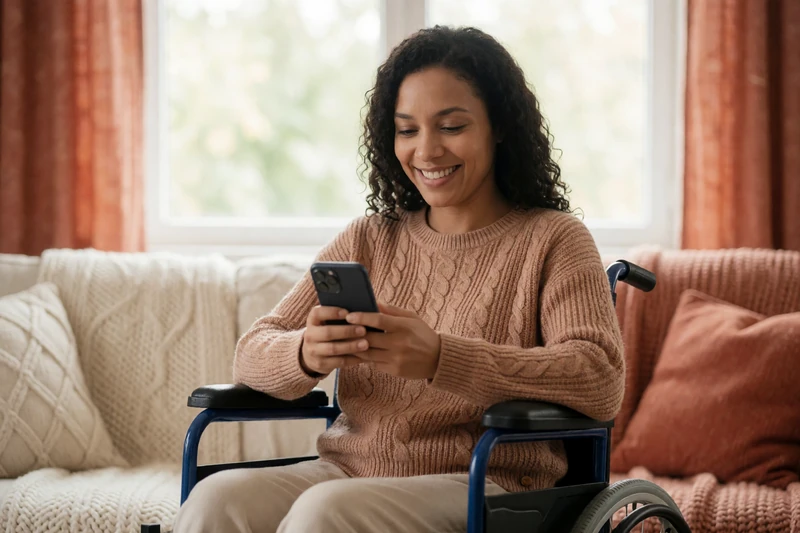
The pattern is clear: every feature on OpenHeartMatch exists because the disability community asked for it. The platform's Vibes matching system and daily Perfect Chat Partner recommendations replace the exhausting swipe-and-scroll model with a calmer, more intentional approach to connection. And because OpenHeartMatch is a 501(c)(3) nonprofit, the basic features - profile creation, matching, and messaging - will always be free.
Frequently Asked Questions
Common questions about accessible dating apps and how OpenHeartMatch compares to mainstream alternatives.
Is there a Tinder for disabled people?
There is no exact equivalent of Tinder built specifically for disabled users, because the swipe-based model itself is inaccessible to many people with motor or visual impairments. OpenHeartMatch is the closest alternative: a disability-focused dating platform with tap-based interaction, full screen reader support, and a values-driven matching system called Vibes that replaces appearance-first swiping.
What is the best dating app for disabled people?
The best dating app for disabled people is one that treats accessibility as a foundation, not an add-on. OpenHeartMatch is built screen-reader-first, offers human moderation to protect against ableist behavior and fetishization, and operates as a nonprofit so basic features stay free. Legacy sites like dating4disabled exist but often have outdated interfaces and limited moderation.
Why do standard dating apps not work well for disabled users?
Standard apps fail disabled users in three key ways: their interfaces are often incompatible with assistive technologies like screen readers, their swipe-based mechanics exclude users with motor impairments, and their moderation systems do not adequately address ableist harassment or fetishization. Without structured disability disclosure options, users are forced to either hide their disability or risk attracting unwanted attention.
Is OpenHeartMatch free to use?
Yes. OpenHeartMatch is a 501(c)(3) nonprofit, and basic features - creating a profile, receiving daily matches, and messaging - are free. The platform is funded through grants and donations rather than paywalling core functionality, so cost is never a barrier to finding connection.